
Your Business
Built Like a Person
Y Intelligence is the layer between your people and the information they need to do their work.
In simple terms: Y is an Enterprise AI platform that helps your business stop relying on scattered files, disconnected systems, and the one person who “just knows”, by bringing your knowledge, processes, and systems into one accessible layer that makes information easier to find, share, and use across your team.
Your Business
Built Like a Person
Y Intelligence is the layer between your people and the information they need to do their work.
In simple terms: Y is an Enterprise AI platform that helps your business stop relying on scattered files, disconnected systems, and the one person who “just knows”, by bringing your knowledge, processes, and systems into one accessible layer that makes information easier to find, share, and use across your team.
What Y offers.
What Y offers.
The architecture
One centralised intelligence layer for the whole business
The Y intelligence layer
Knowledge base & wiki · agent runtime · tools & integrations
The architecture
One centralised intelligence layer for the whole business
The Y intelligence layer
Knowledge base & wiki · agent runtime · tools & integrations
Reach People on the Channels they Already Use
Users gain value without learning a new system. WhatsApp is the recommended starting channel – text and voice – with more added as needs emerge.
Text or voice access for quick, on-the-go answers, ideal for frontline teams, sales staff, customers, and partners.
Microsoft Teams
Internal staff can ask questions, retrieve guidance, and get support without leaving the workspace they already use daily.
Email & Webchat
Supports formal requests, website enquiries, portal support, follow-ups, and recorded interactions in one familiar flow.
API Access
Connects Y into existing portals, apps, and workflows, adding intelligence directly into the systems already in use.
Measured on your numbers, not ours
Rather than estimate returns in the abstract, we baseline the value levers most relevant to you at the start of the pilot – then track movement against them, together.
Staff time released
Reduce the hours spent searching for information, answering repeated questions, checking systems manually, and relying on senior staff for routine guidance.
Faster Response
Give staff, customers, and partners quicker answers through familiar channels, reducing delays across enquiries, support, orders, and internal requests.
Improved Cashflow
Support faster follow-up on orders, invoices, collections, and overdue accounts by making the right information easier to access and act on.
Fewer Errors
Reduce mistakes caused by outdated information, manual lookups, inconsistent answers, duplicated work, or uncertainty around the correct process.
Knowledge Retained
Capture important business knowledge in a structured environment, reducing the risk of information being lost when key people are unavailable or leave.
Consistent Answers
Ensure teams, branches, customers, and partners receive the same approved guidance, regardless of who asks, where they ask, or which channel they use.
Where to use Y
Built for every moment of your business.
- Knowledge ManagementA central structured knowledge base and wiki
- AI-Assisted RetrievalAsk in natural language and get context-aware answers
- C&S InteractionCustomers and Staff reached through familiar channels
- System IntegrationCustom tools connect to ERP and operational systems
- Workflow & AutomationSupport repeatable processes to increase efficiency
- Training and EnablementStaff learn from structured company knowledge
Knowledge Management
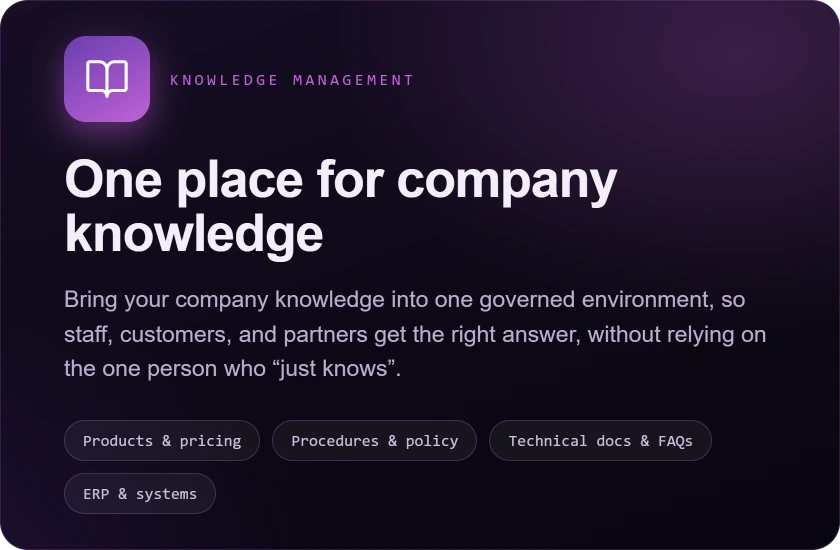
Knowledge Management focuses on creating a central, structured source of truth for the organisation, reducing reliance on informal knowledge held by individuals, scattered documents, or disconnected systems.
This is particularly critical in businesses where important operational, product, customer, or process knowledge is spread across teams, emails, files, and key personnel. When knowledge is not properly captured and maintained, it can lead to inconsistent answers, slower onboarding, repeated mistakes, and unnecessary dependence on specific individuals.
Y addresses this by helping organisations build and maintain a structured knowledge base and wiki, supported by AI-assisted content generation and intelligent retrieval. Existing materials such as documents, policies, procedures, FAQs, product information, training content, and system data can be organised into a central knowledge environment that is easy to search, update, and govern.
With role-based access, approved content, and real-time insights, Y ensures that knowledge remains current, accessible, and consistently applied across the business. The result is less key-person dependency, faster access to information, and a more scalable way to manage organisational knowledge.
AI-Assisted Retrieval
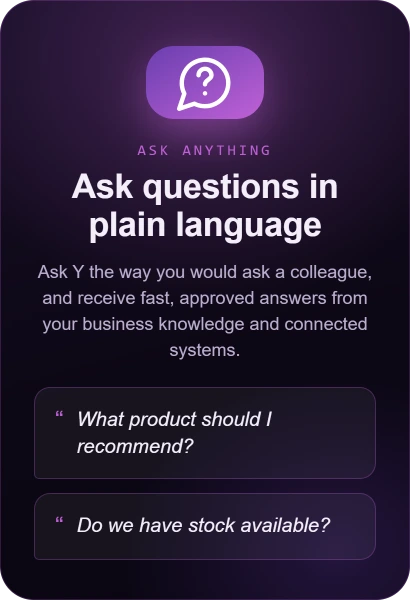
AI-Assisted Retrieval focuses on enabling users to ask questions in natural language and receive accurate, context-aware answers from approved company information, without needing to manually search through documents, folders, systems, or ask specific individuals.
This is particularly critical in businesses where important knowledge is spread across policies, procedures, product information, training material, customer records, operational documents, and internal systems. When information is difficult to find or inconsistently interpreted, it can slow decision-making, create repeated questions, increase dependency on key people, and lead to inconsistent service or execution.
Y addresses this by connecting approved company knowledge to an intelligent retrieval layer that understands user questions and returns relevant, governed responses. Users can ask questions in plain language through channels such as WhatsApp, Teams, web chat, email, or API, while Y searches the available knowledge base and connected systems to provide practical, role-appropriate answers.
With role-based access, approved content, and controlled integrations, Y ensures that users receive information they are permitted to access and can trust. The result is faster access to knowledge, fewer repetitive queries, better internal alignment, and a more efficient way for people across the organisation to find and apply the information they need.
"Which customer orders can we fulfill right now?"
"Find the product code for x"
Customer and Staff Interaction
Customer and Staff Interaction focuses on making business knowledge and support accessible through the channels people already use, such as WhatsApp, Teams, email, web chat, or other familiar communication tools, without requiring them to learn a complex new system.
This is particularly critical in organisations where employees, customers, and partners need quick access to accurate information but may not know which system to use, who to contact, or where the latest information is stored. When interaction depends on manual searches, internal escalation, or informal knowledge-sharing, responses become slower, inconsistent, and difficult to scale.
Y addresses this by allowing users to ask questions, request information, or receive guidance through familiar channels, while the platform retrieves answers from approved company knowledge and connected business systems. Whether it is a staff member checking a procedure, a customer asking for product information, or a partner needing support, Y provides a simple conversational layer between people and the information they need.
With controlled access, approved content, and channel-based delivery, Y ensures that interactions remain consistent, governed, and easy to adopt. The result is faster responses, less friction, reduced dependency on internal support teams, and a more accessible way for people to engage with the organisation.
Business-System Integration
Business-System Integration focuses on connecting Y to the operational systems your business already relies on, such as ERP, CRM, finance, inventory, support, or workflow platforms, so users can retrieve live information and trigger agreed actions from a simple conversational interface.
This is particularly critical in organisations where important information sits inside multiple systems and can only be accessed by trained users or specific departments. When staff, customers, or partners need to wait for someone to check stock, confirm pricing, retrieve an order status, or update a record, processes become slower, more manual, and harder to scale.
Y addresses this through custom tools that connect to approved business systems and allow users to request information or initiate actions in natural language. For example, Y can retrieve live customer details, stock availability, pricing, order information, policy data, or operational updates, while also supporting controlled actions such as creating tasks, sending notifications, escalating requests, or triggering predefined workflows.
With role-based access, controlled permissions, and clear integration boundaries, Y ensures that system interaction remains secure, governed, and aligned to business rules. The result is faster access to live information, fewer manual lookups, reduced operational friction, and a more connected experience across the organisation.
Workflow and Automation
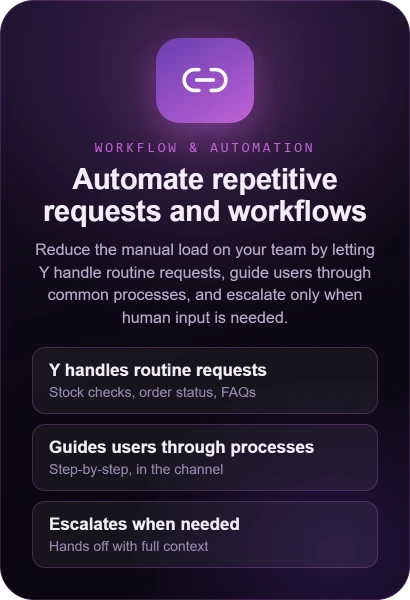
Workflow and Automation focuses on supporting repeatable business processes such as enquiries, stock checks, support requests, guidance, reminders, escalations, and other routine interactions that often depend on manual follow-up or specific individuals.
This is particularly critical in organisations where teams handle high volumes of recurring requests or rely on consistent execution across departments, branches, customers, or partners. When these processes are handled manually, they can become slow, inconsistent, difficult to track, and heavily dependent on staff knowing exactly who to ask or which system to check.
Y addresses this by using approved knowledge, connected systems, and custom tools to guide users through common processes and trigger predefined actions. For example, Y can help answer an enquiry, check live stock or pricing, guide a user through a procedure, create a support task, send a notification, or escalate an issue to the right person or team.
With controlled permissions, defined workflows, and clear escalation rules, Y ensures that automation remains practical, governed, and aligned to business operations. The result is faster turnaround times, reduced manual effort, more consistent execution, and a scalable way to support everyday business processes.
Training and Enablement
Training and Enablement focuses on helping staff learn from structured company knowledge, reducing the pressure on senior people, managers, or key employees who are often relied on to explain processes, answer repeated questions, or transfer institutional knowledge.
This is particularly critical in organisations where knowledge sits with experienced individuals rather than in a clear, reusable format. When staff depend on informal explanations, ad hoc guidance, or shadowing alone, training becomes inconsistent, onboarding takes longer, and senior team members lose time repeatedly answering the same questions.
Y addresses this by turning approved company knowledge into structured learning and practical guidance that staff can access when they need it. Policies, procedures, product information, system guides, FAQs, and internal documentation can be organised into learning paths, searchable knowledge areas, and role-specific support material.
With integrated delivery, role-based access, and visibility into usage or completion, Y helps ensure that staff are enabled consistently across departments, branches, or teams. The result is faster onboarding, better knowledge transfer, less dependency on senior people, and a more scalable way to build capability across the organisation.
Why Businesses bring Y in
Faster
Access
Natural-language answers cut search time and day-to-day delays.
Improved
Consistency
A common, approved base standardises responses across the business.
Operational
Efficiency
Fewer repetitive queries, manual searches and escalations over time.
Secure and
Controlled
Data isolation and role-based access keep AI inside an approved environment.
Centralised Knowledge
One controlled environment instead of scattered documents and inboxes.
Less Key-Person
Risk
Critical knowledge is captured, reducing continuity risk.
Better
Service
Immediate product guidance at all times.
Take a closer look
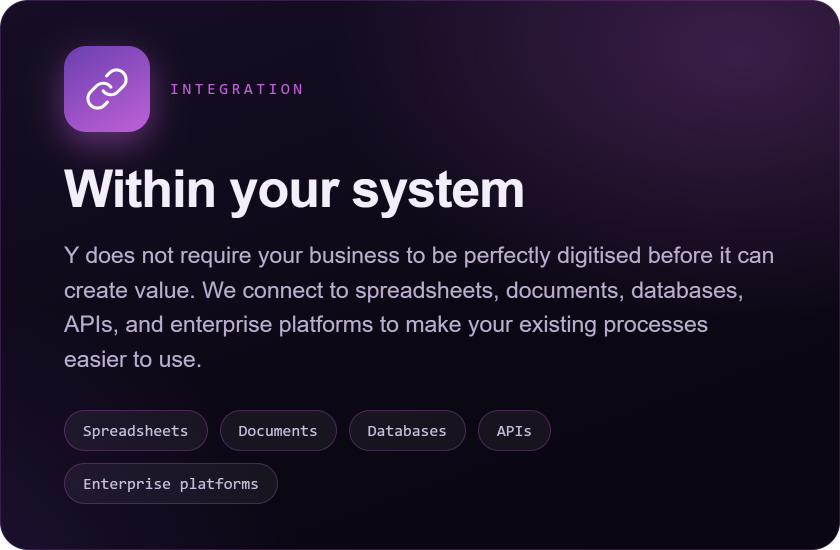
Whether your business runs on excel spreadsheets or enterprise systems Y will work