Skip to Content

Training & Enablement

Training and Enablement is about turning company knowledge into structured, interactive learning that helps employees understand, apply, and retain what they need to know.

Rather than relying only on static documents, manual training sessions, shadowing, or senior people repeating the same explanations, Y Intelligence helps create structured training courses from the organisation’s existing knowledge.

This may include onboarding material, policies, procedures, product documentation, system guides, SOPs, compliance documents, FAQs, internal process notes, and operational best practice.

The key difference is that Y does not only present information. It can teach, test, respond to learner performance, identify areas of weakness, and adjust the learning experience to reinforce topics where the user needs more support.

Book a Demo 

Y creates structured training from your existing documents, teaches users interactively, adapts when they get something wrong, and retests them to confirm understanding.

AI in Action
Training and Enablement

The Pain Point

Training is often manual, inconsistent, hard to measure, and too dependent on senior people.

In many organisations, training is inconsistent, manual, and difficult to measure.

New employees often learn by asking colleagues, reading scattered documents, shadowing senior staff, or waiting for someone to explain the correct process. Existing employees may also struggle when products change, policies are updated, systems are introduced, or compliance requirements evolve.


This creates major problems:

  • New employees take longer to become productive.
  • Senior staff spend time repeating the same explanations.
  • Training quality varies across teams, branches, or departments.
  • Employees may complete training without fully understanding the content.
  • Managers lack visibility into who understands what.
  • Knowledge gaps are often only discovered after mistakes happen.
  • Updated procedures do not always reach everyone.
  • Compliance training can be difficult to prove, track, and maintain.
The issue is not only whether training exists. The issue is whether the training is structured, interactive, measurable, and able to respond when someone does not understand a topic properly.

What Y Offers

Y creates training courses from existing documents and adapts learning when users struggle.

Y Intelligence turns approved business knowledge into structured training courses that can be delivered, tested, tracked, and improved over time.

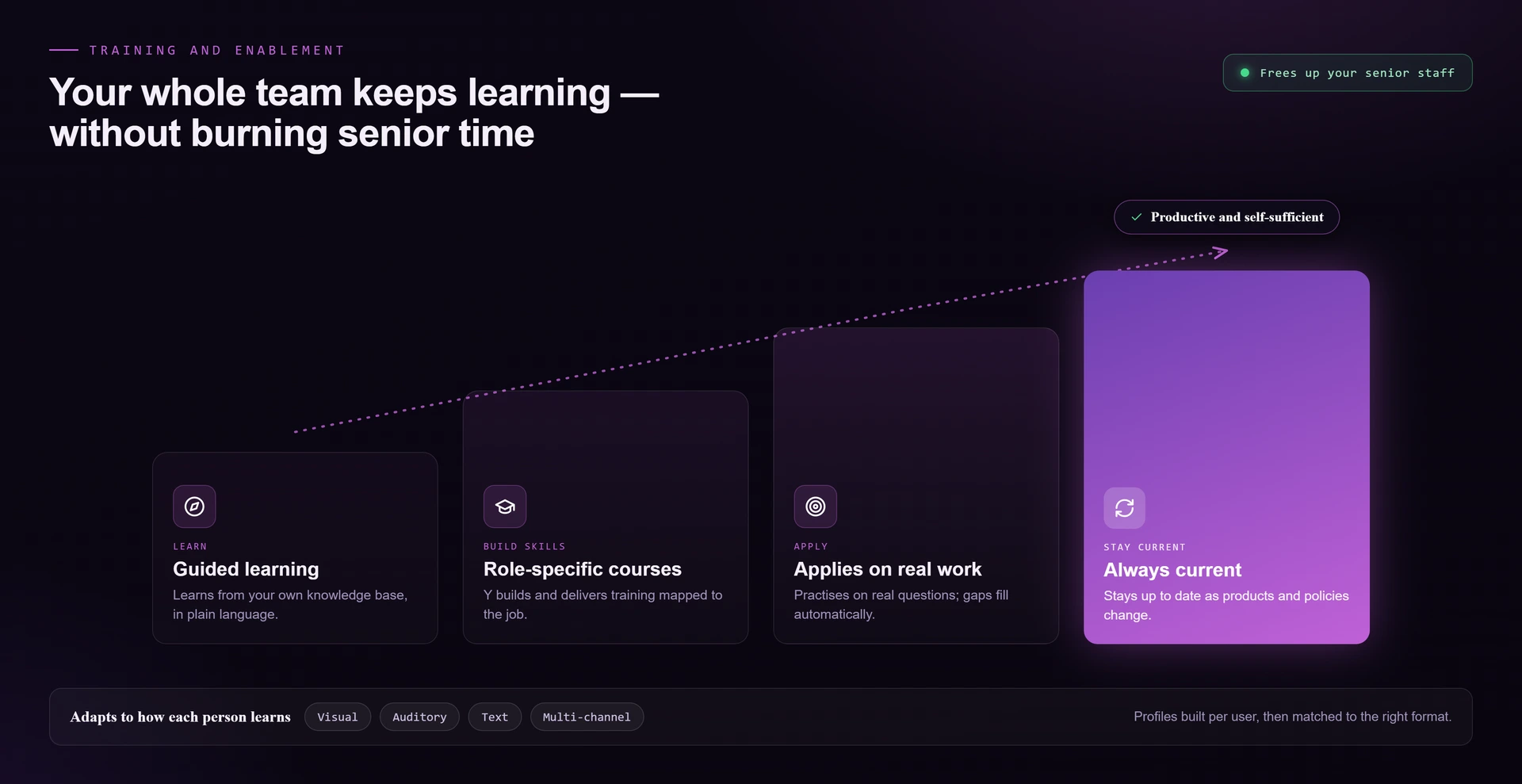
The organisation can provide Y with source material such as policies, procedures, product documents, system guides, SOPs, compliance requirements, or internal knowledge bases. Y can then help structure that material into lessons, modules, learning paths, knowledge checks, assessments, and role-specific training journeys.

Where Y becomes more powerful is in the learning experience itself. If a user gets a question wrong or shows weakness in a certain area, Y can identify the knowledge gap, reinforce the relevant topic, adjust the lesson flow, and retest the user to confirm understanding.

This means training becomes more than content delivery. It becomes a smarter enablement process that helps ensure people actually understand and apply the knowledge.

How it Works

Y structures content into lessons, assessments, learning paths, knowledge checks, and tracked progress.

Y can use existing company materials as the foundation for training and enablement.

These may include:


  • Onboarding documents
  • Training manuals
  • SOPs
  • Policies and procedures
  • Product documentation
  • System guides
  • Role descriptions
  • FAQs
  • Compliance documents
  • Process maps
  • Internal knowledge bases
  • Spreadsheets and operational documents
  • Recorded guidance or internal notes
Y can then help convert these materials into structured training courses, including modules, lessons, summaries, examples, assessments, and follow-up learning activities.

Training can be tailored by role, department, seniority, branch, region, product area, or compliance requirement. For example, a sales person, support agent, branch manager, and finance user may all need training on the same business process, but each may need it explained in a different way.

Y can also track progress, completion, assessment results, repeated errors, and areas where users may need additional teaching. This makes it possible to maintain visibility over training adoption, identify knowledge gaps, and support compliance reporting where required.

Why it Matters

People do not just access information; they learn it, apply it, and prove understanding.


.

Training and Enablement matters because businesses need people to understand knowledge, not just have access to it.

A document in a folder does not guarantee learning. A once-off training session does not guarantee retention. A completed course does not always mean the person can apply the process correctly.

Y helps close that gap by making training more structured, interactive, and responsive.

This improves:

  • Onboarding speed
  • Staff confidence
  • Training consistency
  • Knowledge retention
  • Compliance visibility
  • Process understanding
  • Product knowledge
  • Role-specific capability
  • Managerial oversight
  • Reduced pressure on senior people

It is especially valuable in organisations with growing teams, distributed branches, franchise networks, compliance requirements, changing products, complex processes, or high dependency on experienced staff.

Example Use Cases

Y can support onboarding, compliance, product training, system training, process learning, and retesting.

A new employee starts their role.

Y creates or delivers an onboarding path based on the company’s policies, systems, processes, and role-specific responsibilities. If the employee struggles with a topic, Y reinforces that section and retests understanding.

A sales person completes product training.

If they answer positioning or objection-handling questions incorrectly, Y identifies the weak area, provides additional explanation, gives examples, and tests again before marking the topic as understood.

A support agent learns a new process.

Y walks them through the approved procedure, checks their understanding, and provides scenario-based questions to confirm they can apply the process correctly.

A compliance manager needs proof of training.

Y tracks who has completed the required training, who still needs to complete it, and where users may have failed or needed additional support.

A manager wants to understand team knowledge gaps.

Y can highlight the topics staff are struggling with most often, helping the business improve training material or provide targeted support.

A product update is released.

Y can help convert the updated documentation into a short learning module, notify the relevant users, and test understanding to ensure the update has been absorbed.

Business Impact

Y reduces training effort, improves consistency, identifies knowledge gaps, and supports compliance tracking.

Training and Enablement creates value by making training easier to create, easier to deliver, and easier to measure.

It helps businesses:


  • Reduce manual training effort
  • Create structured courses from existing documents
  • Improve onboarding consistency
  • Reduce repeated questions to senior staff
  • Identify knowledge gaps before they become operational problems
  • Retest users where understanding is weak
  • Track completion and support compliance requirements
  • Keep training aligned as processes, products, and policies change
  • Scale training without increasing the burden on managers
This capability is powerful because it connects training directly to the organisation’s knowledge base. The same approved knowledge that supports answers, workflows, and system guidance can also be used to teach staff, test understanding, and maintain compliance.

Website Positioning

Y turns company knowledge into smart, trackable training that improves understanding over time.

Training and Enablement turns company knowledge into structured, interactive learning that can be delivered, tested, tracked, and improved over time.

Y helps create training from existing documents and knowledge sources, adapts the learning experience when users struggle, and provides visibility into progress, understanding, and compliance.