Skip to Content

Workflow & Automation

Workflow and Automation is about helping users complete repeatable business processes faster, with less manual effort and fewer unnecessary handovers.

Many business requests follow a familiar pattern: someone asks a question, someone checks a system, someone confirms a rule, someone sends an update, someone creates a task, and someone escalates the issue if it cannot be resolved immediately.

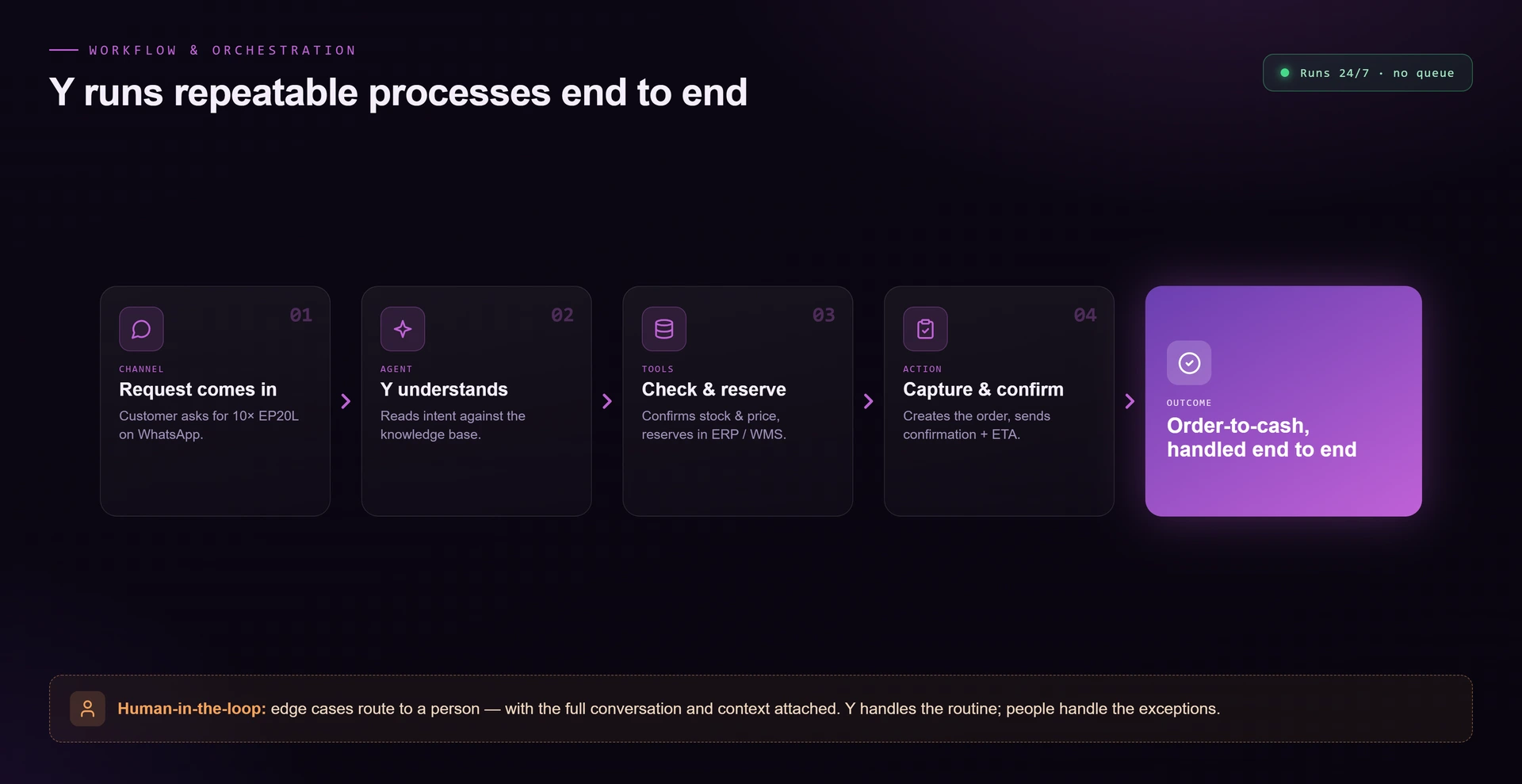
Y Intelligence can support these repeatable processes by guiding users through the correct steps, retrieving the information required, triggering approved actions, and escalating only when human input is genuinely needed.

This means Y is not only a tool for answering questions. It can become a practical workflow layer that helps move requests from enquiry to resolution.

Book a Demo 

A user asks Y to check an order, create a ticket, send a reminder, or escalate an issue, and Y follows the approved workflow to move the request forward automatically.

AI in Action
Workflow and Automation

The Pain Point

Information often exists, but it is difficult to find quickly, confidently, and consistently.

In many organisations, routine processes are handled manually every day.

Teams receive repeated requests for order updates, stock checks, support queries, customer guidance, internal approvals, policy clarification, document requirements, account follow-ups, and operational escalations.


This creates major problems:

  • Staff spend time answering the same questions repeatedly.
  • Requests are routed manually between teams.
  • Simple issues wait in queues unnecessarily.
  • Processes are followed inconsistently.
  • Customers and staff wait for basic updates.
  • Managers have limited visibility over repeated bottlenecks.
  • Internal teams become overloaded with low-value admin.
  • Important requests can be missed, delayed, or sent to the wrong person.
The issue is not always that the process is complicated. Often, the process is known, but it depends on people remembering the correct steps, checking the right information, and manually moving the request forward.

What Y Offers

Y gives users a simple way to retrieve approved answers from company knowledge and connected systems.

Y Intelligence helps automate and guide repeatable requests and workflows.

A user can ask Y to check something, explain a process, start a request, create a task, send a notification, or escalate an issue. Y then follows the approved logic for that process.

For example, Y can:

  • Answer routine enquiries
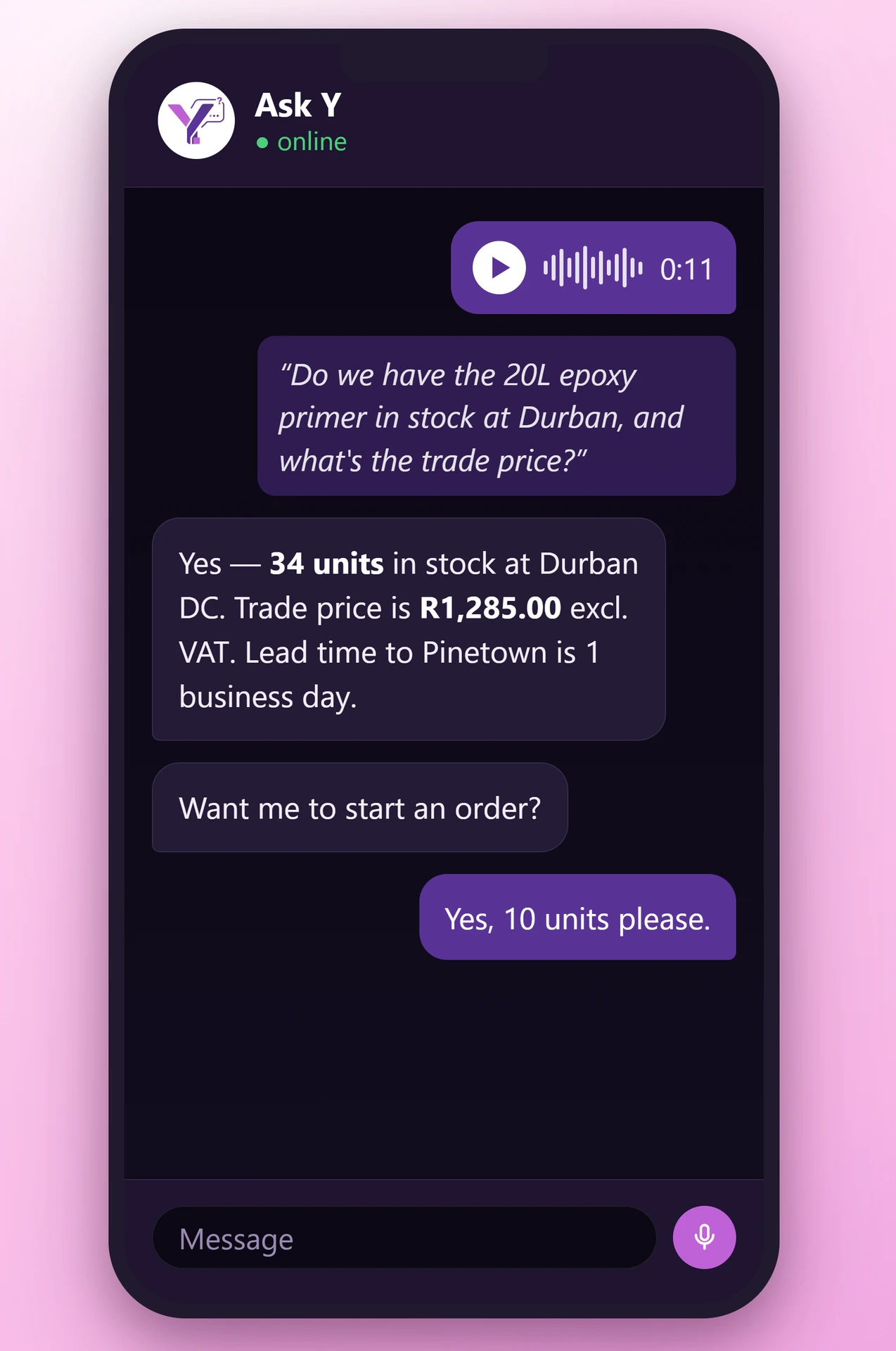
  • Check stock or order status
  • Guide users through an internal process
  • Capture required information
  • Create support tickets
  • Send reminders or notifications
  • Route requests to the correct team
  • Escalate exceptions to a human
  • Trigger approval workflows
  • Summarise repeated requests or bottlenecks

This allows the business to reduce the amount of manual coordination required for everyday work.

The value is that Y can handle the predictable parts of a process, while people focus on the decisions, exceptions, and relationships that genuinely need human judgement.

How it Works

Y interprets the question, searches approved sources, and returns relevant answers based on user access.

Y can be configured around the organisation’s existing processes, whether those processes are fully systemised or still managed through spreadsheets, email, documents, and human handovers.

A workflow can be built using:


  • Approved business rules
  • Process documents
  • SOPs
  • System integrations
  • Forms and required fields
  • Escalation logic
  • Role-based permissions
  • Approval rules
  • Notifications and reminders
  • Task management systems
  • CRM, ERP, support, or finance data
  • Spreadsheet-based process data
When a request comes in, Y can identify what the user is trying to do, ask for missing information, check the relevant source, guide the user through the next step, and trigger the correct action where permitted.

For example, if a customer asks for an order update, Y can retrieve the order status and respond directly. If the order is delayed beyond an agreed threshold, Y can escalate the issue to the correct team. If a support request requires a ticket, Y can capture the details and create the task automatically.

This creates a more structured and reliable way to handle repeatable work.


Why it Matters

People get the information they need faster, without searching, waiting, or escalating unnecessarily.


.

Workflow and Automation matters because many businesses lose time in small, repeated operational interactions.

One manual stock check, one support escalation, or one internal request may not seem like much on its own. But across hundreds or thousands of interactions, the cost becomes significant.

By automating the predictable parts of these processes, Y helps reduce pressure on teams and improve consistency.

This improves:

  • Turnaround times
  • Operational efficiency
  • Customer response times
  • Staff productivity
  • Process consistency
  • Internal visibility
  • Escalation accuracy
  • Support capacity
  • Service quality

It is especially valuable in businesses with high volumes of enquiries, distributed teams, repeated support requests, stock or order queries, finance follow-ups, approval processes, or customer-facing operations.


Example Use Cases

Users can ask about orders, stock, pricing, policies, processes, products, support, or customer records.


“Can I get an update on my order?”

Angela
Customer

Instead of someone manually checking the system, confirming the status, and replying, Y retrieves the order details, responds instantly, and if the order is delayed, automatically flags or escalates it to the correct team.


“How do I handle this customer complaint?”

Jim
Support Member

Rather than searching for the process, filling out forms, and forwarding emails, Y guides the staff member step by step, captures the required information, logs the complaint, and routes it to the appropriate team in one flow.


“Can you check stock and send the customer the next step?”

Siphiwe
Sales Person

Instead of checking inventory, drafting a response, and setting a reminder, Y retrieves stock levels, prepares the response, and can automatically send the update or create a follow-up task.


“Can you create a ticket for this issue?”

Thandiwe
Support Agent

Rather than manually entering details into a system, Y captures the issue, structures the required fields, creates the ticket, and assigns it based on routing rules from a single request.

“Can you remind the account manager to follow up on this overdue invoice?”

Jonothan
Finance Member

Instead of tracking the invoice, drafting a message, and sending reminders, Y identifies the overdue account and automatically sends or schedules the reminder through the correct channel.


“Which workflow requests are being escalated most often?”

Rob
Manager

Instead of reviewing reports or compiling data manually, Y analyses repeated requests and provides a summary of escalation patterns to highlight where processes may need improvement.

Business Impact

Y reduces repeated questions, improves response times, and makes business knowledge easier to use.

Workflow and Automation creates value by reducing manual effort across repeatable processes.

It helps businesses:


  • Reduce repetitive admin
  • Resolve routine requests faster
  • Improve process consistency
  • Reduce unnecessary escalations
  • Make teams less dependent on manual handovers
  • Ensure requests are routed correctly
  • Improve visibility over operational bottlenecks
  • Free staff to focus on higher-value work
  • Create a foundation for deeper process automation
This capability is powerful because Y can automate around the business as it exists today. The process does not need to be perfect, fully digitised, or already embedded in an enterprise system. Y can support workflows that live in documents, spreadsheets, emails, databases, or existing platforms.

Website Positioning

Ask Y in plain language and get approved answers without needing to know where to look.

Workflow and Automation allows Y to handle routine requests, guide users through common processes, trigger approved actions, and escalate only when human input is needed.

Y reduces the manual load on your team by automating the predictable parts of everyday work, while keeping people involved where judgement, approval, or exception handling is required.