Skip to Content

Customer & Staff Interaction

Customer and Staff Interaction gives people access to Y through the channels they already use, rather than forcing them to learn another system.

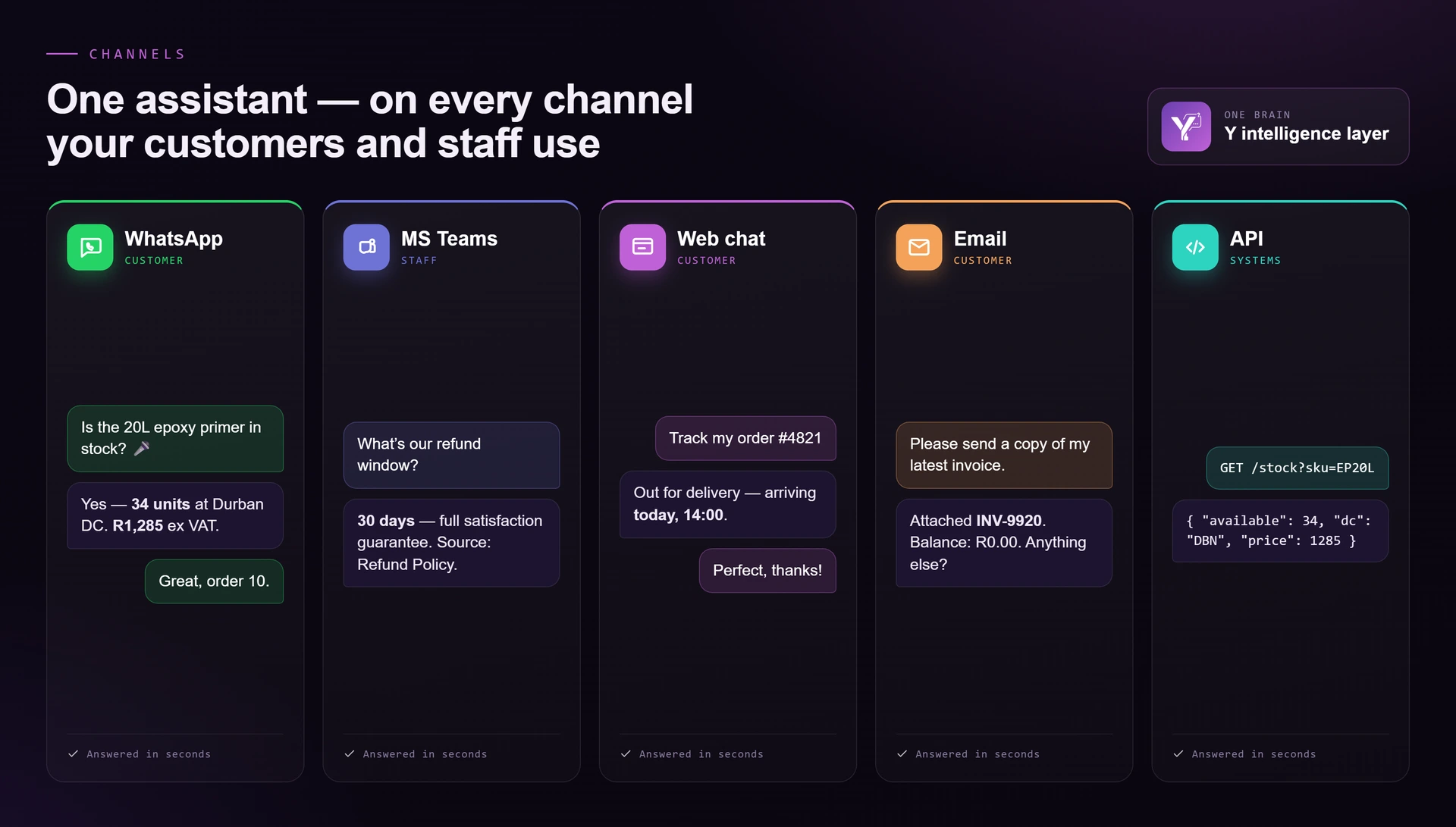
Instead of logging into separate portals or searching across systems, staff, customers, and partners can interact with business knowledge and support through familiar channels like WhatsApp, Microsoft Teams, Email, Web Chat, or existing portals.

This makes Y easier to adopt, allowing users to ask questions, request information, receive guidance, or start workflows from tools they already use.

It creates a simple conversational layer between people and the organisation’s knowledge, systems, and processes.

Book a Demo 

A customer sends a website enquiry, a sales rep asks a WhatsApp voice note, or a staff member asks in Teams, and Y responds with approved information, live system context, or a guided next step.

AI in Action
Knowledge Management

The Pain Point

People struggle to access business knowledge when it is locked inside systems, teams, or departments.

Many businesses have systems and knowledge available, but they are not easy for everyone to access.

Staff may need to know which platform to use, where a document sits, who to contact, or which department owns the information. Customers and partners often have even less visibility, meaning they need to phone, email, wait for a response, or rely on manual support from internal teams.


This creates major problems:

  • Staff waste time switching between systems.
  • Customers wait for basic answers.
  • Support teams deal with repetitive queries.
  • Information is shared inconsistently across channels.
  • Frontline teams rely on back-office staff for simple updates.
  • Partners struggle to access the information they need.
  • Adoption is low when users must learn another platform.
  • Internal teams become overloaded with routine requests.
The issue is not only whether information exists. The issue is whether people can access it easily, in the moment they need it, through a channel they are willing to use.

What Y Offers

Y lets staff, customers, and partners ask questions, request support, and start workflows easily.

Y Intelligence gives staff, customers, and partners a simple way to interact with the organisation through familiar communication channels.

A staff member can ask a policy question in Teams.

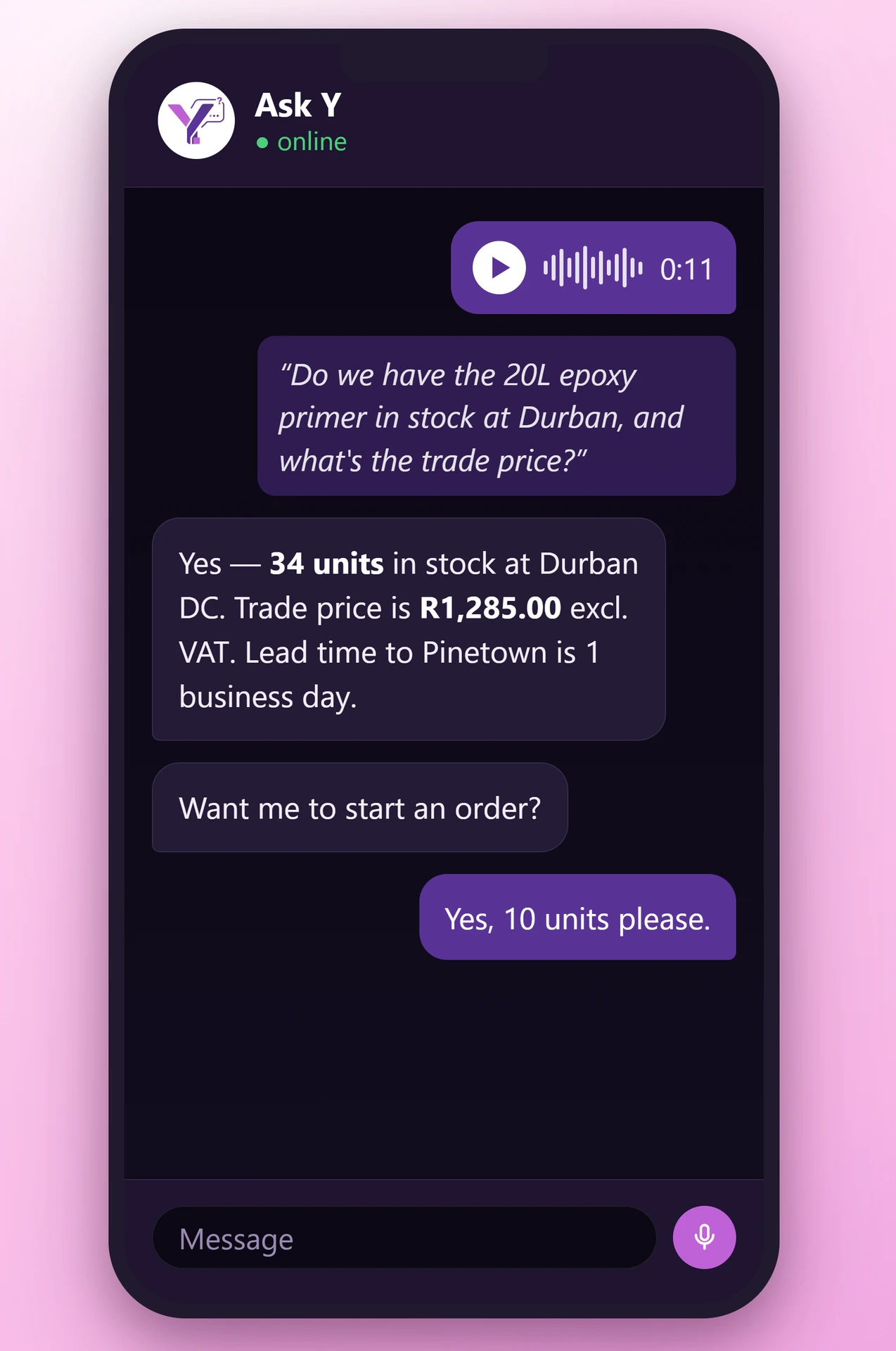
A sales representative can send a WhatsApp voice note asking for product or stock information.

A customer can ask for an order update through Web Chat.

A partner can email a request and receive a structured response or escalation.

Y can then retrieve the relevant approved knowledge, check connected systems where required, guide the user through the correct process, or escalate the request to the right person when human input is needed.

This allows the organisation to move from scattered, manual, channel-by-channel support to a more consistent and connected interaction layer.

The value is that people do not need to learn where everything lives. They can simply interact with Y through the channels they already use.

How it Works

Y connects to channels like WhatsApp, Teams, Email, Web Chat, portals, and business systems.

Y can be made available across different channels depending on the needs of the organisation.

These may include:

  • WhatsApp
  • Microsoft Teams
  • Email
  • Web Chat
  • Existing customer portals
  • Internal business portals
  • API-based system access
  • Mobile or web applications

Each channel can be configured for a specific audience and purpose.


WhatsApp may be used for frontline staff, sales teams, customers, or external partners who need quick answers on the move. Microsoft Teams may be used for internal staff who already collaborate there. Email and Web Chat may support more formal requests, website enquiries, support queries, or customer-facing interactions.

Example

Y can also manage different access levels depending on who is asking. A customer may only receive information relevant to their account or enquiry, while an employee may access internal policies, procedures, and operational guidance. A manager may receive broader reporting or escalation information.

This means the same intelligence layer can serve different users, through different channels, while still maintaining governance and control.

Why it Matters

People adopt Y faster because they do not need to learn another complex platform.


.

Customer and Staff Interaction matters because adoption is one of the biggest barriers to successful technology.

A powerful system is only useful if people actually use it.

By placing Y in familiar channels, the organisation removes friction. Users do not need to remember another login, learn a new interface, or know where information is stored. They can ask questions naturally and receive support in the same way they already communicate.

This improves:

  • User adoption
  • Response times
  • Customer experience
  • Staff productivity
  • Partner engagement
  • Support consistency
  • Channel efficiency
  • Operational accessibility
  • Internal and external service quality

It is especially valuable in organisations with frontline teams, distributed branches, customer service functions, field staff, sales teams, franchise networks, or external partners.


Example Use Cases

Users can ask about orders, policies, stock, support, complaints, documents, or internal processes.


“Where is my order?”

Angela
Customer - Through WebChat

Y retrieves the available order information and provides a clear update or routes the request if it needs human attention.


“What is the process for approving this customer request?”

Jim
Staff Member - Through Microsoft Teams

Y returns the relevant internal guidance and next steps.


“Do we have this item in stock, and what should I recommend as an alternative?”

Siphiwe
Sales Person - Through Voice Note on WhatsApp

Y retrieves the available product or stock information and provides practical guidance.


“What documents are required for this application?”

Thandiwe
CEO - Through Email

Y responds with the approved requirements or escalates the query if it falls outside the defined process.


“Can you log a support request for this issue?”

Rob
Employee - Through Company System

Y captures the request, structures the information, logs the support request, and routes it to the right team.

Business Impact

Y reduces repetitive queries, improves response times, and makes support easier to scale.

Customer and Staff Interaction creates value by making business knowledge and support easier to access.

It helps businesses:


  • Reduce repetitive support queries
  • Improve customer response times
  • Increase staff self-service
  • Reduce pressure on internal teams
  • Improve consistency across communication channels
  • Make knowledge available to frontline and external users
  • Support customers, staff, and partners from one intelligence layer
  • Increase adoption by meeting users where they already work
  • Escalate complex requests more efficiently
This capability is important because even the best knowledge base or workflow system has limited value if people do not engage with it. Y solves this by making interaction simple, familiar, and accessible.

Website Positioning

Y meets people where they already work, making business knowledge easier to access and use.

Customer and Staff Interaction allows people to access Y through the channels they already use, including WhatsApp, Microsoft Teams, Email, Web Chat, and existing portals.

Whether the user is an employee, customer, partner, sales representative, support agent, or manager, Y provides a simple way to ask questions, retrieve information, follow guided processes, and escalate requests when human input is needed.